BBAR G2 (Broad-Band Anti-Reflection Generation 2) Coating
Innovative coating technology that prevents ghosting and flare

Model A057
NIKON Z,
SONY E
Unprecedented ultra-telephoto 500mm zoom sets your creative vision free
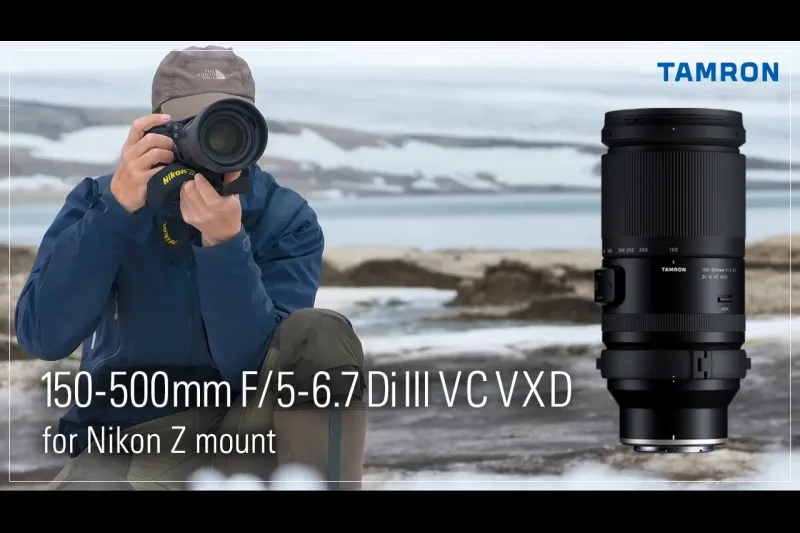
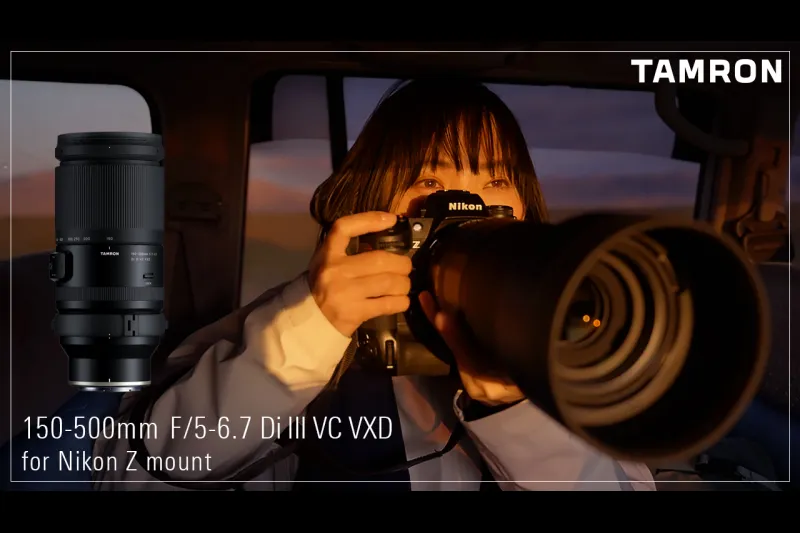
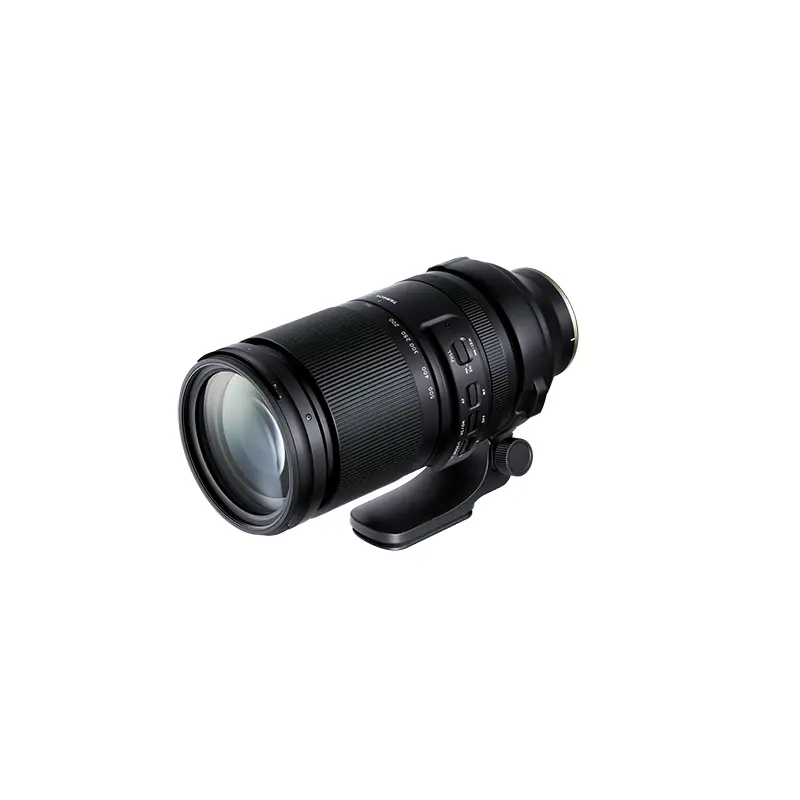
Considering its pairing with mirrorless cameras, TAMRON pursued a compact size that allows handheld shooting while developing the 150-500mm F5-6.7 (a full-frame equivalent of 225-750mm on APS-C cameras)1. With a length of 209.6mm (8.3in)2 and maximum diameter of 93mm, the 150-500mm F5-6.7 is astonishingly compact for a 500mm-class ultra-telephoto zoom lens. Even when extended to the 500mm telephoto end, the lens has a length of around 283mm (11.1in)2. Another distinctive feature is that the arc of rotation of the zoom ring is small—only 75°—which enables swift adjustment to the desired focal length with minimal movement.
1 When a full-frame camera is used, focal length is 150-500mm.
When an APS-C camera is used, the focal length is 225-750mm (full-frame equivalent).
2 Length and weight are based on the Sony-mount lens.

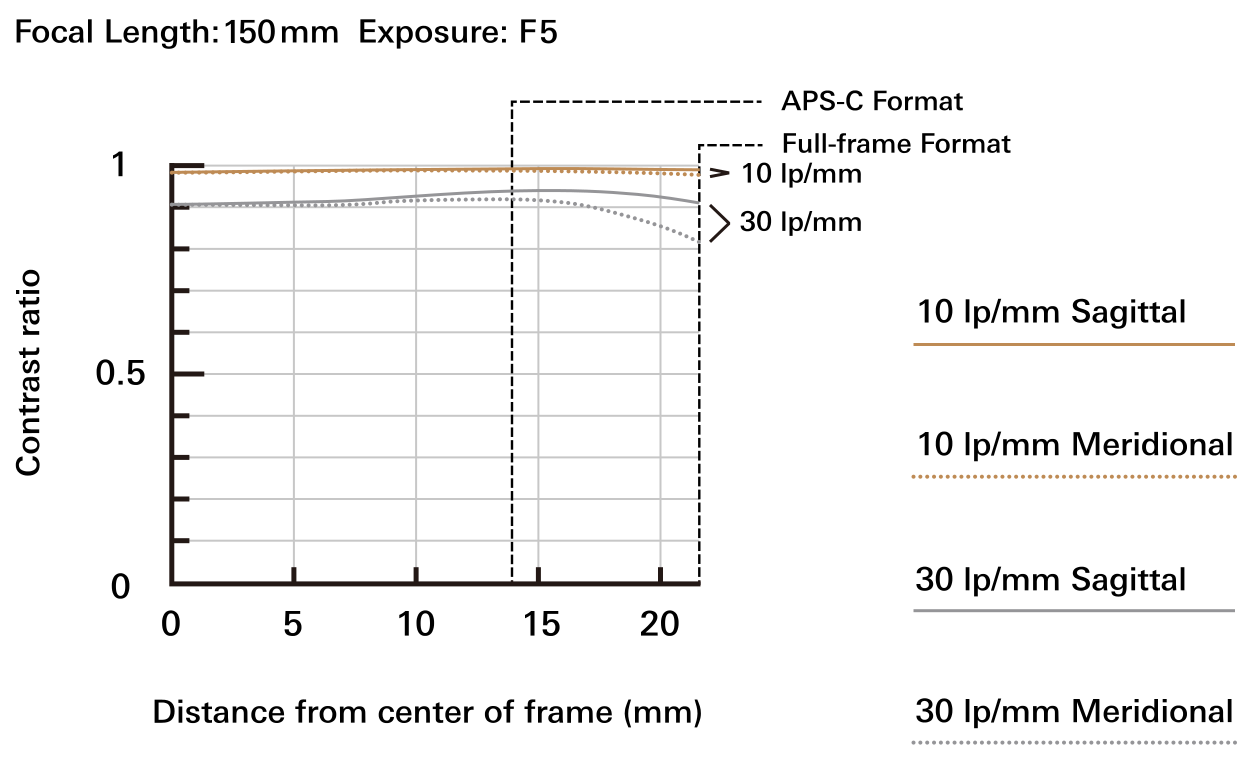
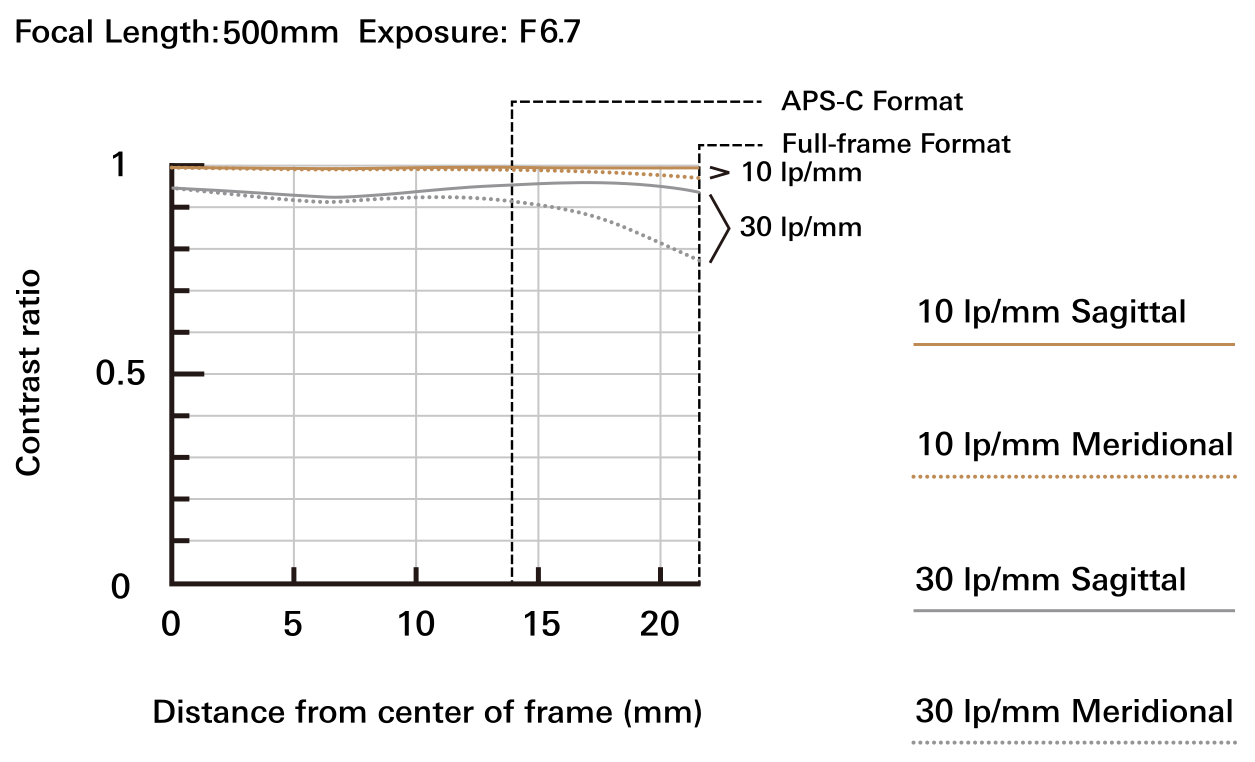
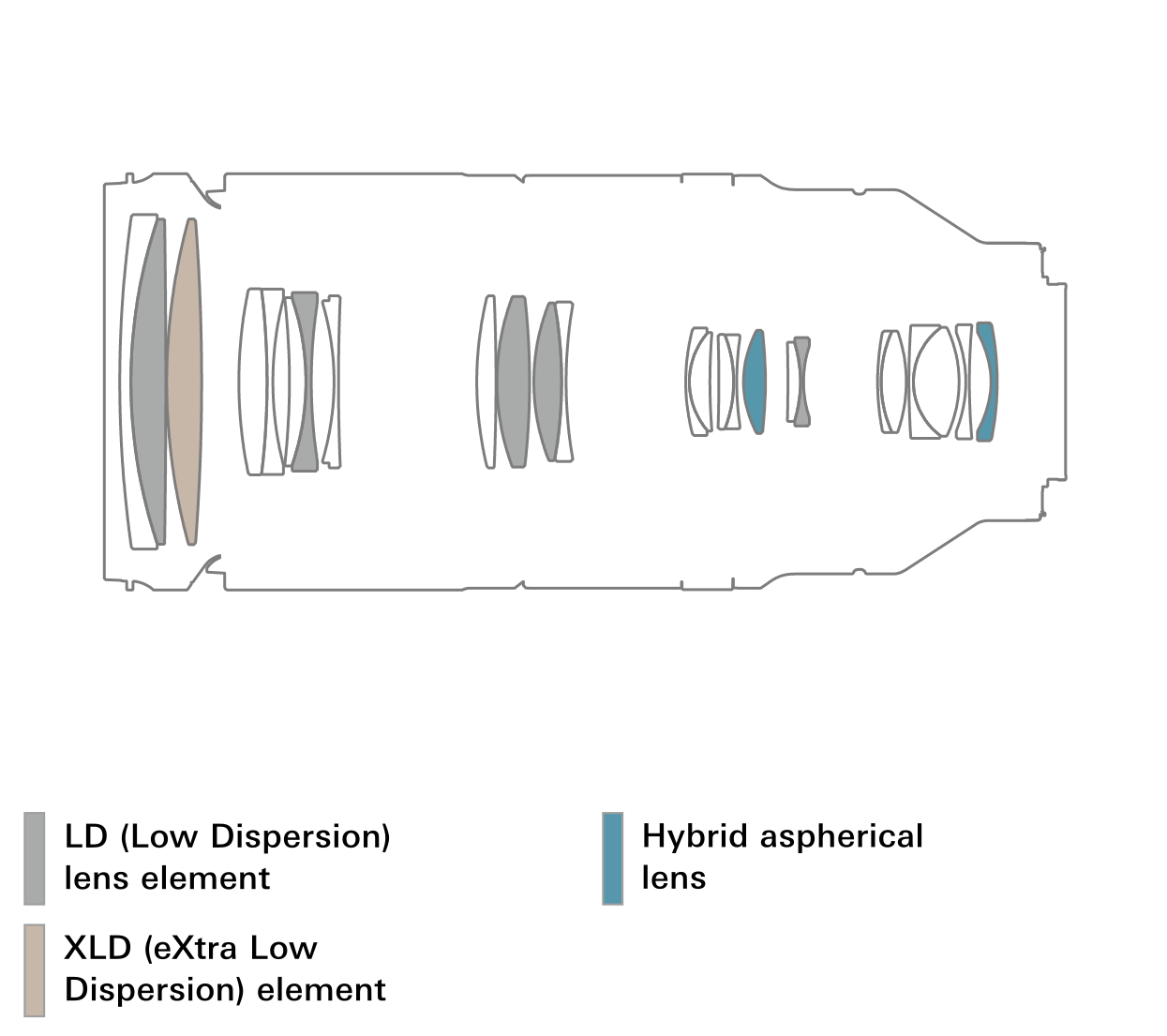
In addition to covering a broad range of focal lengths, the 150-500mm F5-6.7 has high resolving power with excellent image-rendering performance across the entire zoom range. The optical construction features 25 elements in 16 groups. The effective placement of special lens elements—including one XLD (eXtra Low Dispersion), five LD (Low Dispersion) and two hybrid aspherical lens elements—enables the 150-500mm F5-6.7 to produce clear images while controlling chromatic aberrations. BBAR-G2 (Broad-Band Anti-Reflection Generation 2) Coating is used to suppress ghosting and flare, which commonly occur under backlit conditions. These features allow the lens to produce finely detailed images of a wide variety of subjects including wild animals, birds, nature, and sports, while producing soft and beautiful bokeh effects.


The 150-500mm F5-6.7 zoom’s AF drive system is equipped with the VXD (Voice-coil eXtreme-torque Drive) linear motor focus mechanism. VXD delivers extreme high-speed and high-precision movement and ensures exceptionally responsive performance. Focus tracking performance is also very high. The linear motor also suppresses drive noise and vibrations during focusing, making it ideal for shooting both still photos and video in environments that demand quietness.
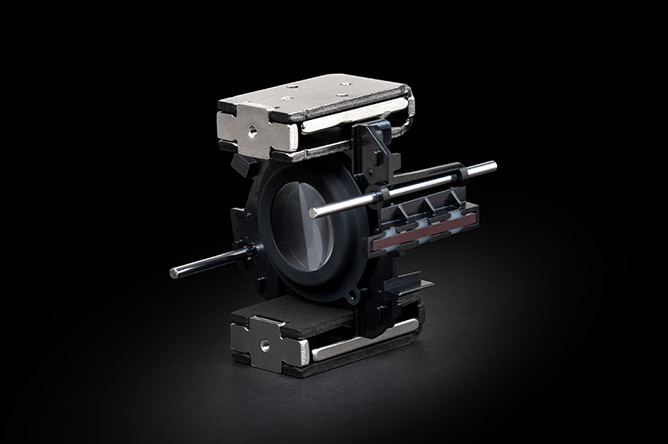

When shooting in the ultra-telephoto range, even the smallest vibrations can lead to loss of image clarity. The 150-500mm F5-6.7 is equipped with VC (Vibration Compensation)3 functionality to support sharp images despite unavoidable camera shake. VC delivers powerful support for handheld shooting of scenes with low light levels, such as evening scenes and indoor shots, without the use of a tripod.
3 For 150-500mm F5-6.7 for Nikon Z mount, VC ON/OFF should be selected on the camera body.
 Camera: Sony α7R IV Focal length: 500mm Exposure: F6.7 1/30sec ISO 3200
The 150-500mm F5-6.7 lets users freely enjoy telephoto macro shooting of subjects at close-up distances. The lens has an MOD of 0.6m (23.6in) at the 150mm end, and 1.8m (70.9in) at the 500mm end. More remarkably, the maximum magnification ratio at the 150mm end is 1:3.1, offering excellent close-up shooting capabilities for an ultra-telephoto zoom lens. In addition to capturing dynamic shots by getting close to the subject, it enables tele-macro photography at close range, something that is not possible with conventional ultra-telephoto zoom lenses. The 150-500mm F5-6.7 can be used in a wide range of situations from plants to insects to tabletop photography.
 Camera: Sony α7R IV Focal length: 150mm Exposure: F8 1/100sec ISO 400
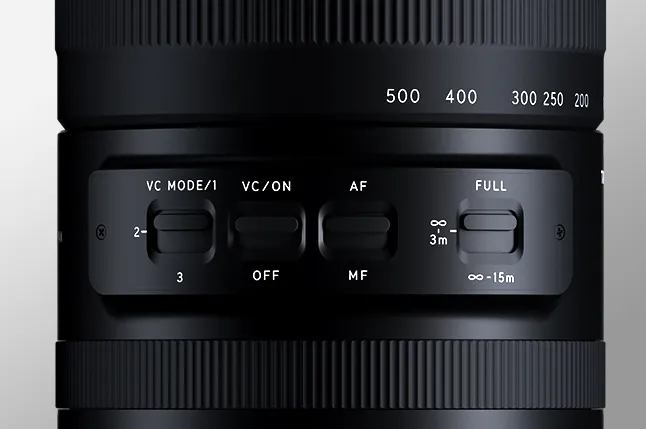
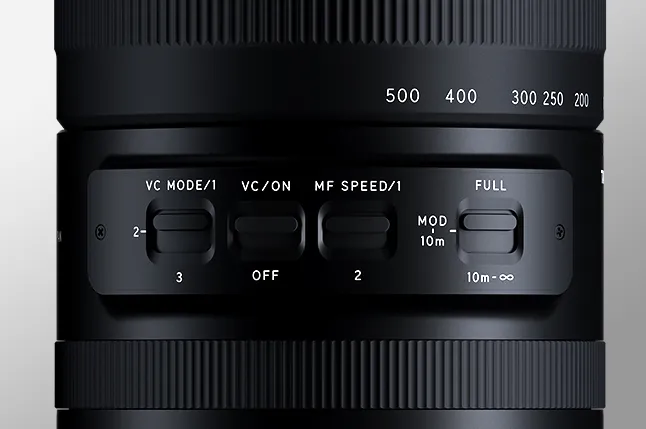
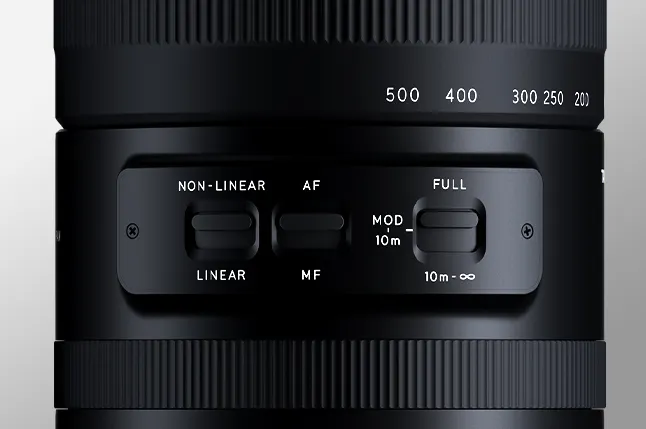
Switchboxes of the 150-500mm F5-6.7 employs different functions for each compatible mount.
[For Sony E and FUJIFILM X mount]
The Sony E and FUJIFILM X mount versions feature a VC mode selection switch with three modes, thereby enabling selection of the ideal VC mode to match shooting conditions and preferences.
Mode 1: Standard
Mode 2: Exclusively for panning
Mode 3: Framing priority
[For FUJIFILM X mount]
The FUJIFILM X mount version features an “MF SPEED” switch. The switch allows you to select between focusing speed during manual focus shooting. This switch is useful when focusing changes from close range to telephoto side.
Mode 1: For normal manual focusing
Mode 2: When fine manual focusing adjustment is required
[For Nikon Z mount]
The Nikon Z mount version features a Linear/Non-Linear switch to change the response of the focus ring when using manual focusing. This allows you to shoot according to your intention.
Non-Linear: The rotation speed of the focus ring changes the amount of focus movement.
Linear: The rotation angle of the focus ring changes the amount of focus movement.
With the Nikon Z mount version, users can employ the dedicated TAMRON Lens Utility software that was developed in-house by TAMRON4. This application enables users to easily update the lens to the latest firmware themselves without going through the camera5.
4 To connect your PC and lens, use the TAMRON Connection Cable (USB Type-A to Type-C/ Model CC-150, or USB Type-C to Type-C/ Model CC-350) sold separately.
5 As the 150-500mm F5-6.7 is not equipped with a Focus Set Button, certain functions cannot be customized.
 * For Model A047
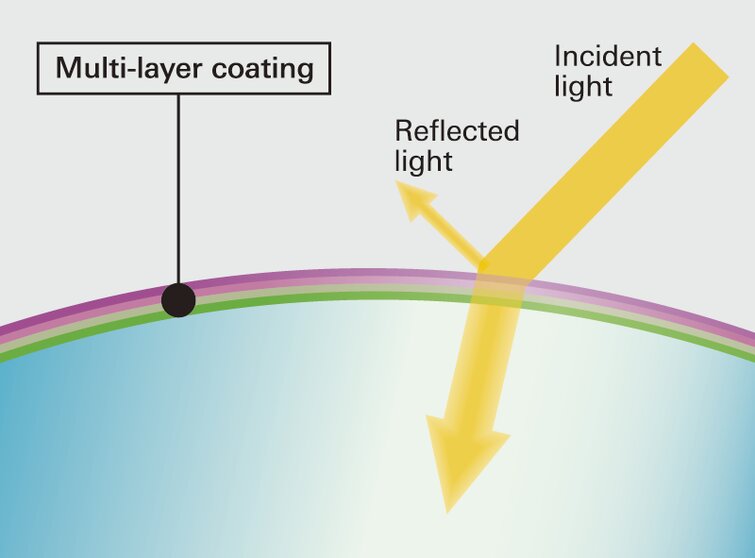
Innovative coating technology that prevents ghosting and flare
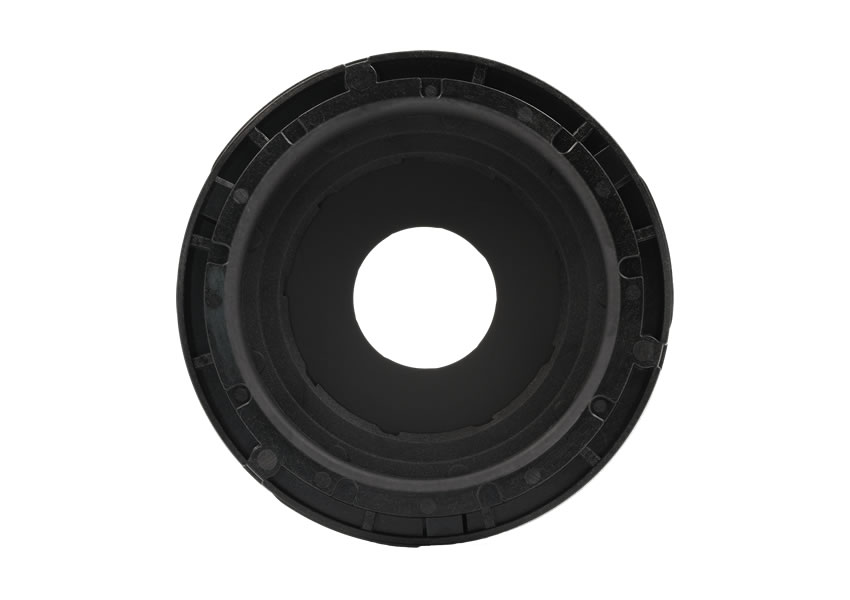
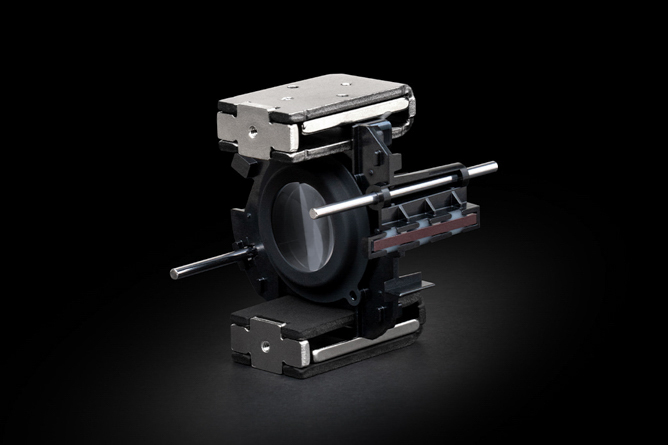
A several-blade diaphragm is configured to retain a smooth, circular-shaped aperture opening even when stopped down by two stops from the wide-open aperture
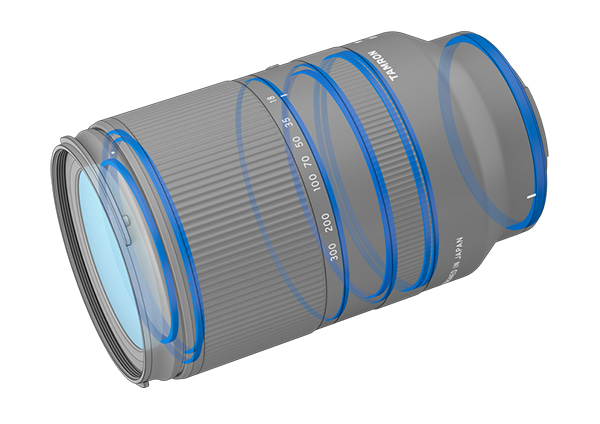
Leak-resistant seals throughout the lens barrel help protect your equipment when shooting outdoors
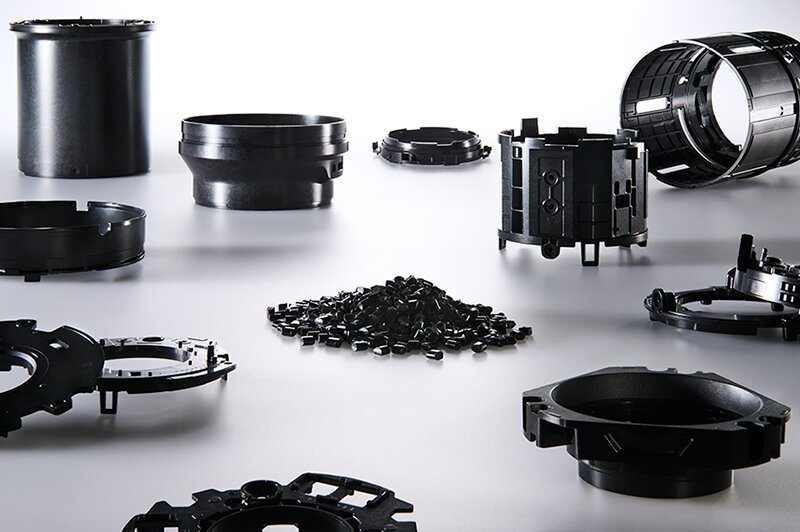
Polycarbonate is the material used whenever TAMRON produces high-precision components that require the strength to withstand rigorous use
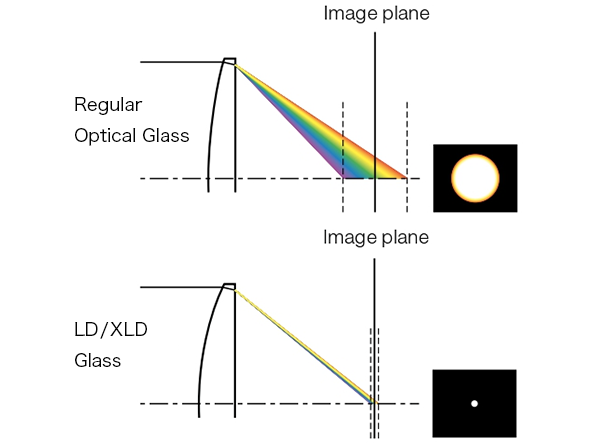
XLD lens elements made from specialized ultra-high-grade glass allow much greater control over chromatic aberration and magnification aberrations
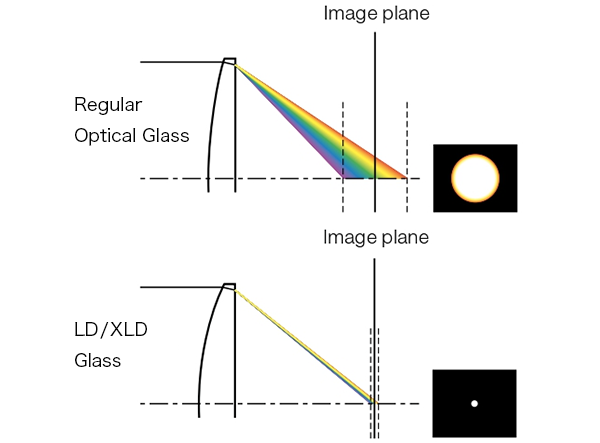
The characteristic of less of a tendency to separate a ray of light into a rainbow of colors effectively compensates for chromatic and lateral chromatic aberration
A highly durable protective fluorine compound that is water- and oil-repellant
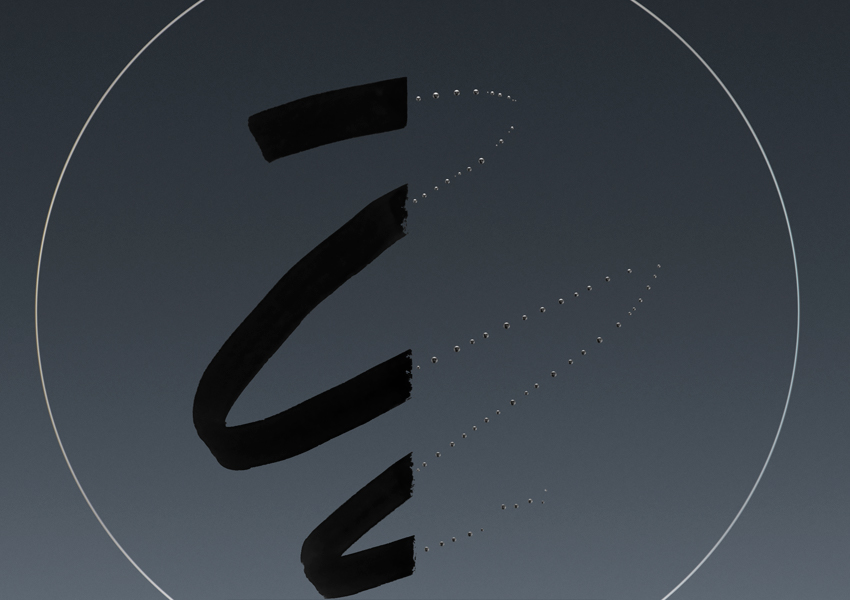
A linear motor focus mechanism for the highest levels of autofocus speed and precision
| Angle of View (diagonal) | 16°25′- 4°57 (for full-frame mirrorless format) 10°59′- 3°18′ (for APS-C frame mirrorless format) |
|---|---|
| Optical Construction | 25 elements in 16 groups |
| Minimum Object Distance | 0.6m (23.6 in) (WIDE) / 1.8m (70.9 in) (TELE) |
| Maximum Magnification Ratio | 1:3.1 (WIDE) / 1:3.7 (TELE) |
| Filter Size | Φ82mm |
| Maximum Diameter | Φ93mm |
| Length* | 209.6mm / 8.3 in (Sony) 212.3mm / 8.4in (Nikon) |
| Weight | 1,725g / 60.8oz (w/o tripod mount) / (Sony) 1,720g / 60.7oz (w/o tripod mount) / (Nikon) tripod mount 155g / 5.5oz |
| Aperture Blades | 7 (circular diaphragm)** |
| Minimum Aperture | F22-32 |
| Standard Accessory | Round-shaped hood, Lens caps, Tripod mount |
| Mount | SONY E Mount , NIKON Z Mount |
| Release Date | June 10, 2021 (SONY E Mount) , October 31, 2023 (NIKON Z Mount) |
* Length is the distance from the front tip of the lens to the lens mount face.
** The circular diaphragm stays almost perfectly circular up to two stops down from maximum aperture.
Specifications, appearance, functionality, etc. are subject to change without prior notice.
This product is developed, manufactured, and sold based on the specifications of E-mount which was disclosed by Sony Corporation under the license agreement with Sony Corporation.
This product is developed, manufactured, and sold under the license agreement with Nikon Corporation.

Nikon Z 9
419mm
F6.3
1/1000sec
ISO 200
8256px ✕ 5504px (16.7MB)

Sony α7R IV
500mm
F8
1/1600sec
ISO400
5400px × 3600px (39.5MB)

Sony α1
500mm
F6.7
1/1600sec
ISO200
5400px × 3600px (20.4MB)